1
Test before you eliminate
Carry more credible hits into physical IgG testing instead of choosing the winners while they are still only sequences, display hits or model outputs.
Every discovery campaign creates more plausible antibodies than you can afford to carry forward. Fynd Bio makes full-length, glycosylated IgGs in hours, so you can put more candidates through physical testing before deciding which ones deserve the expensive work.
For research use only. Expression performance depends on sequence and workflow conditions.
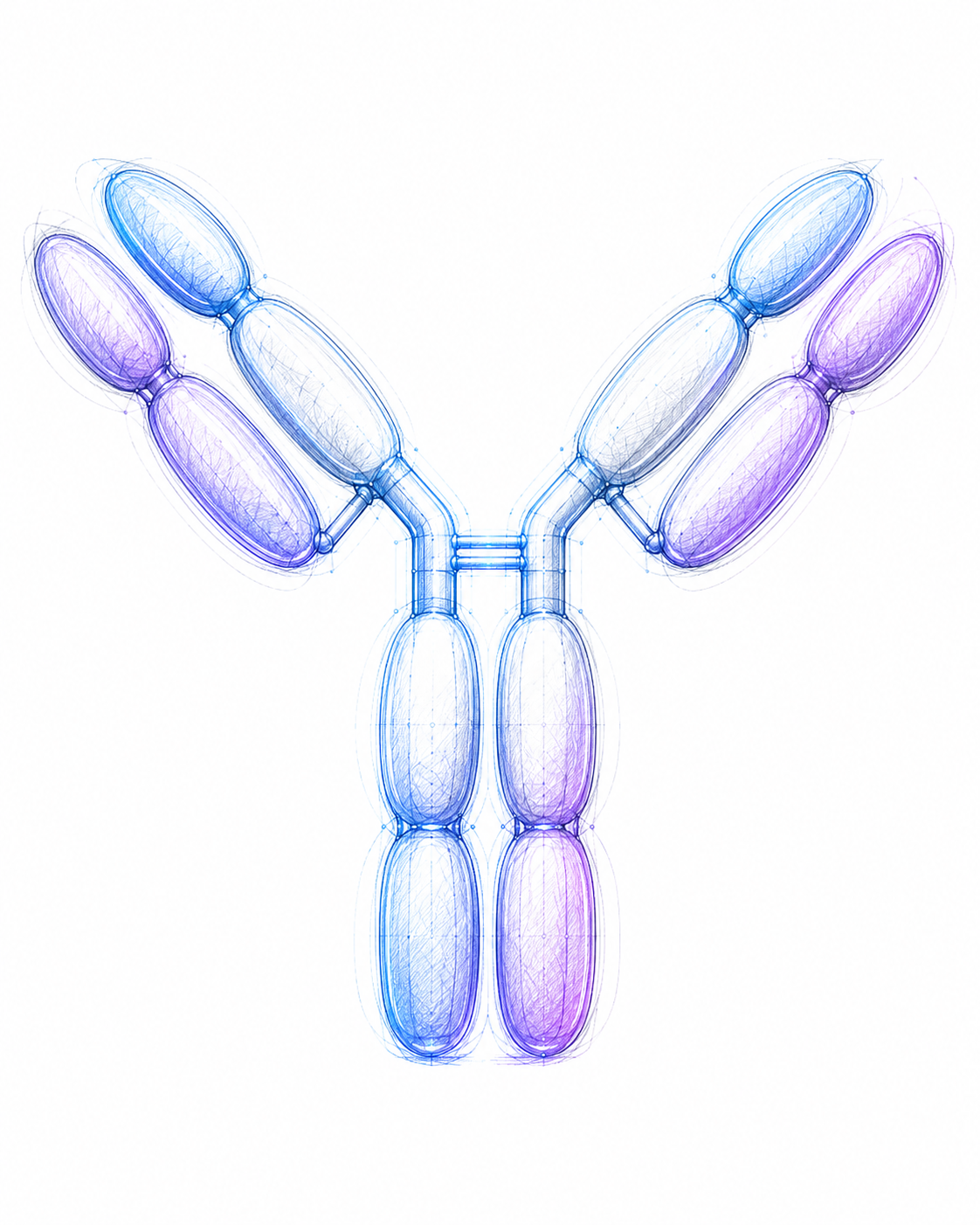
The first few micrograms can answer questions that determine whether the next milligram is worth making. Fynd moves physical IgG testing earlier—when changing your mind is still cheap—so more of the funnel is narrowed by data rather than production constraints.
Carry more credible hits into physical IgG testing instead of choosing the winners while they are still only sequences, display hits or model outputs.
Compare candidates as full-length, glycosylated IgGs before committing to a lead on the basis of a surrogate format.
Make screening-scale material for the decision in front of you. Move to conventional production when a candidate has earned the next investment.
Fynd Bio produces full-length, glycosylated IgGs in mammalian cell-free systems. Choose a human HEK- or CHO-derived environment so early ranking is based on a more relevant molecular format. Glycosylation can significantly affect developability, binding kinetics and Fc function.
See the primary evidence →Discovery is increasingly good at generating candidates. The bottleneck is turning enough of them into the physical molecule you actually want to compare. Fynd compresses that step without requiring intact-cell growth or transfection.
Use compatible linear or plasmid templates. For workflows that already generate DNA, ask us about direct template strategies that can reduce unnecessary rebuilding between discovery and expression.
Generate assembled, glycosylated antibody in a human HEK- or CHO-derived cell-free environment without growing or transfecting intact cells.
Take the IgG into the assay that determines what happens next—binding, kinetics, developability, functional screening or your own downstream workflow.
Fynd is built around a simple standard: rapid expression should not require you to abandon the molecular features you are trying to evaluate. The platform has produced full-length trastuzumab IgG in mammalian cell-free reactions, with HEK- and CHO-derived systems providing mammalian glycosylation environments and related workflows supporting rapid binding measurements.
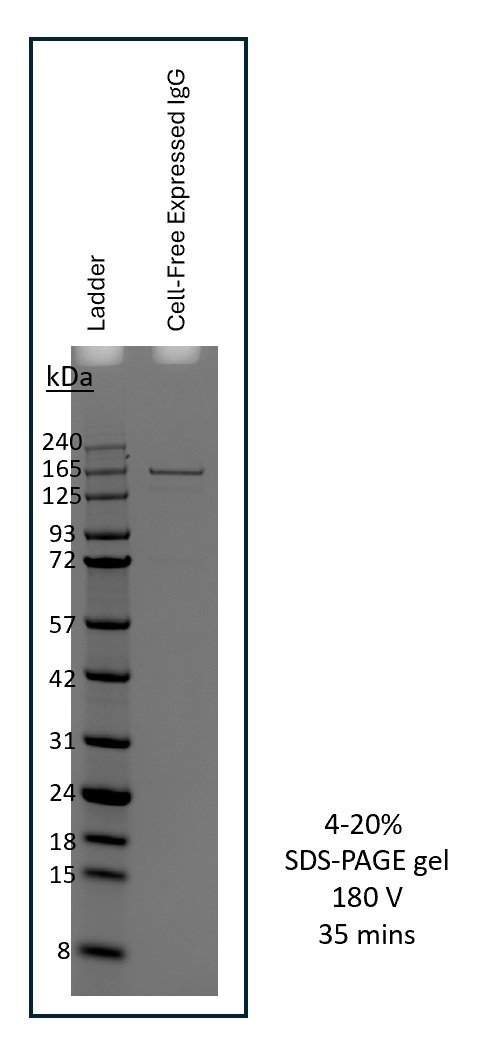
Choose a human HEK or CHO-derived system. Non-reducing and reducing SDS-PAGE workflows provide direct confirmation of assembled IgG and heavy/light chains.
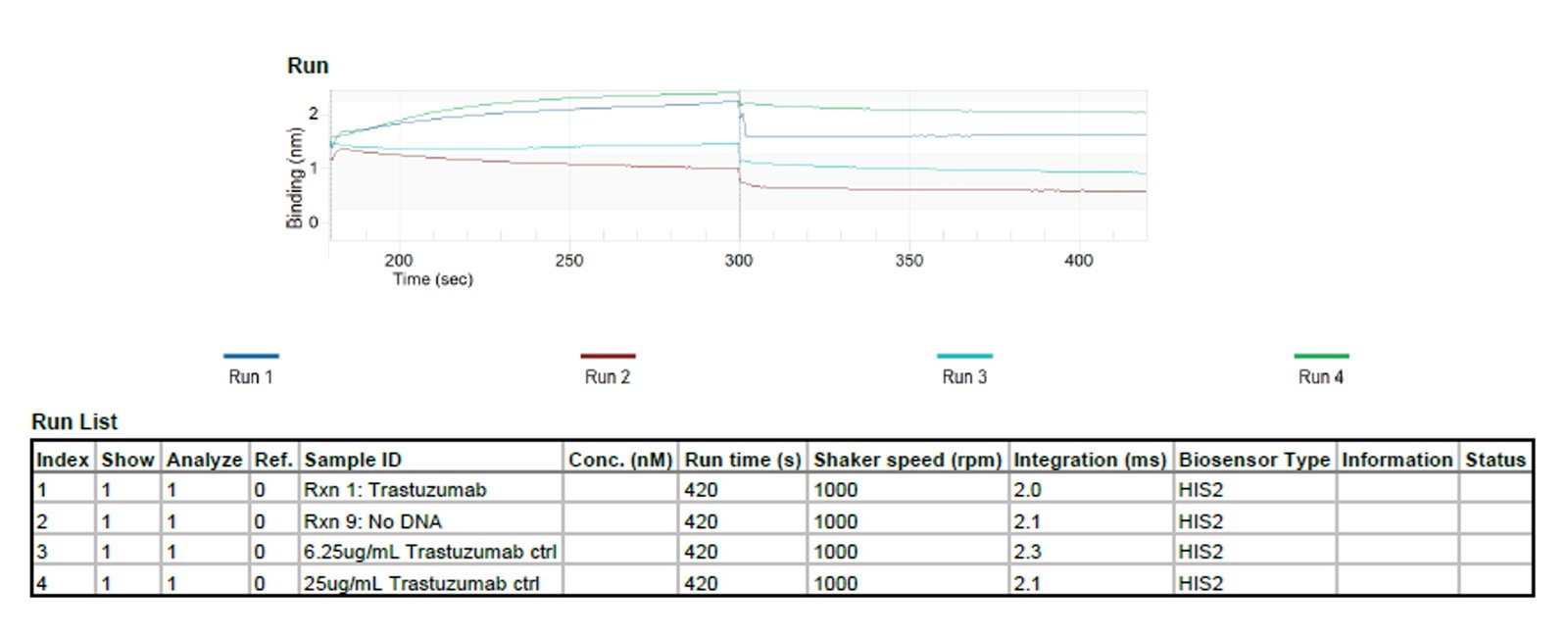
Cell-free-produced binders can move rapidly into affinity testing, including measurements from crude reaction material.
AI, display, B-cell discovery and lead optimization create candidates in very different ways. They converge on the same question: which sequences are worth carrying forward as full-length IgGs?
Models can generate candidates faster than conventional expression can validate them. Turn more designs into physical IgG data per round, then feed the evidence back into the next design cycle.
A hit in phage, yeast, Fab, scFv or another discovery context is not yet the therapeutic-format molecule. Re-test more winners as full-length, glycosylated IgGs before the funnel closes.
Read the evidence →B-cell workflows can recover large numbers of paired antibody sequences—and in some workflows, physical DNA as well. Fynd can help move those hits toward screening-scale IgG without treating every candidate like a development-scale production project.
When one lead becomes dozens or hundreds of CDR, Fc or combination variants, make enough of each to compare the neighborhood before scaling the winners.
Tell us what enters your funnel, how many candidates you currently express, and what experiment determines which ones survive. We’ll help you move that experiment earlier with screening-scale, full-length IgG.